90-Day vs. 30-Day Prescription Supply: Which Saves More?
Compare costs, convenience, and coverage rules for 90-day vs. 30-day prescription supplies. Most maintenance medication patients save $100-$400 per year by switching.
> **Quick Answer:** For maintenance medications taken long-term, 90-day supplies typically cost less per day and require four pharmacy trips per year instead of twelve. Most patients on chronic medications save $100–$400 annually by switching.
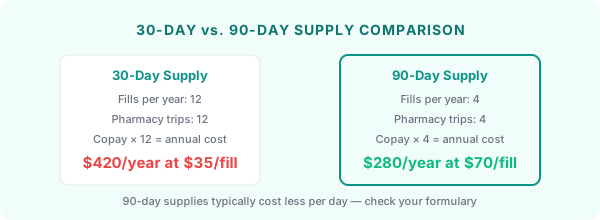
If you take a medication every day for a chronic condition — blood pressure, diabetes, thyroid disease, high cholesterol — you're going to refill it 12 times a year on a 30-day schedule. That's 12 trips to the pharmacy, 12 copay transactions, and 12 opportunities to miss a refill.
Switch to a 90-day supply and you do that four times. The savings aren't just about money. They're about friction.
The Cost Math
Let's look at a realistic example. You take lisinopril 10 mg daily for hypertension. Generic lisinopril is inexpensive, but the copay structure still matters.
**30-day supply at $15 copay:**
- 12 fills per year × $15 = **$180/year**
**90-day supply at $35 copay (typical 2x30 pricing):**
- 4 fills per year × $35 = **$140/year**
That's $40 in savings just on copays. Not dramatic, but multiply it across 3-4 maintenance medications and you're looking at $120-$160 per year.
Now consider a brand-name medication with a $50 copay for 30-day supply and $110 for 90-day:
- 30-day: 12 × $50 = $600/year
- 90-day: 4 × $110 = $440/year
Savings: **$160 per year on a single medication.**
To calculate your own numbers, [use the prescription refill calculator](/prescription-refill-calculator) — enter your fill date, quantity, dosing schedule, and cost per fill to see your projected annual cost. Then re-run the calculation with a 90-day quantity to compare.
Why Most Plans Charge Less for 90-Day Fills
Pharmacy benefit managers (PBMs) price 90-day supplies at roughly 2x the 30-day copay rather than 3x for a few reasons:
1. **Dispensing fee savings.** Pharmacies charge a dispensing fee each time they fill a prescription. For 90 days, that fee is charged once instead of three times.
2. **Mail-order efficiency.** PBMs route most 90-day fills through mail-order pharmacies, which have lower operating costs than retail locations.
3. **Adherence incentives.** Research consistently shows patients on 90-day supplies have better medication adherence. Better adherence means fewer hospitalizations, which reduces plan costs.
Some plans — especially high-deductible health plans and Medicare Part D Advantage plans — require 90-day fills for maintenance medications and charge a penalty for filling at retail after a certain number of fills. Check your Summary of Benefits and Coverage document or call your plan's member services line.
Which Medications Qualify for 90-Day Fills?
Most insurance plans define "maintenance medications" as drugs taken for chronic conditions. Common categories include:
- **Cardiovascular:** ACE inhibitors, beta-blockers, ARBs, statins, calcium channel blockers
- **Endocrine:** Levothyroxine (thyroid), metformin, insulin, GLP-1 agonists, sulfonylureas
- **Mental health:** SSRIs, SNRIs, mood stabilizers (when used long-term)
- **Respiratory:** Inhaled corticosteroids, long-acting bronchodilators for asthma/COPD
- **Musculoskeletal:** Bisphosphonates for osteoporosis
- **Anticoagulants:** Warfarin, direct oral anticoagulants (DOACs) like apixaban and rivaroxaban
Short-course antibiotics, acute pain medications, and schedule II controlled substances are generally excluded from 90-day supply programs.
If you're unsure whether your medication qualifies, ask your pharmacist. They can check your plan's formulary coverage for 90-day supply in about two minutes.
Mail-Order vs. Retail for 90-Day Fills
Many plans offer 90-day fills through both retail pharmacies and mail-order services. Mail-order often has lower out-of-pocket costs but requires planning ahead:
**Retail 90-day:**
- Same-day pickup
- Pharmacist available for questions
- Good for medications that need storage below room temperature
- Some plans charge a higher copay than mail-order
**Mail-order 90-day:**
- Often the lowest out-of-pocket cost
- Requires 7-10 day shipping window (some services offer expedited)
- Not ideal if you're uncertain whether a medication is working yet
- Best for stable, established medications you've been on for 3+ months
For new prescriptions, start with a 30-day fill to confirm the medication works for you. Once your prescriber confirms you'll stay on it long-term, request a 90-day fill.
How to Switch to a 90-Day Supply
The process is easier than most patients expect:
1. **Ask your prescriber to write for a 90-day supply.** This can often be done through a patient portal message or phone call — no appointment needed. Your provider simply writes the prescription with a larger quantity (90 tablets for once-daily, 180 for twice-daily, etc.).
2. **Check your plan's 90-day pharmacy options.** Some plans require you to use their preferred mail-order service for 90-day fills. Log into your member portal or call member services to confirm where you can fill.
3. **Use the early refill date to time the switch.** You can switch supply lengths at any refill. When your current supply hits the [80% threshold](/blog/early-refill-rules), fill the first 90-day supply. Your next refill won't be for another three months.
4. **Set a calendar reminder.** [Calculate your next refill date](/prescription-refill-calculator) using the 90-day quantity and add a reminder 5-7 days before the coverage window opens.
When a 30-Day Supply Makes More Sense
The 90-day supply isn't always better:
- **New medications.** Start with 30 days until you confirm the medication is well-tolerated and effective.
- **Dose adjustments.** If your prescriber might change your dose at a follow-up appointment, a shorter supply avoids waste.
- **Travel medications.** Some international destinations have restrictions on the quantity of medication you can bring in.
- **Medications with short shelf lives.** Some liquids, injectables, and specialty drugs degrade quickly after opening — check with your pharmacist.
- **Schedule II controlled substances.** Federal law limits Schedule II prescriptions to a 30-day supply in most states.
For everything else — especially if you've been on the same dose of a maintenance medication for 6+ months — the 90-day supply is almost always the better choice. Our [guide to managing maintenance medications](/blog/maintenance-medication-tips) covers how to set up a system that keeps you organized regardless of supply length.