Controlled Substance Refill Rules: Schedule II–V Explained
Federal law prohibits Schedule II refills entirely. Schedule III–V allow up to 5 refills in 6 months. Here's exactly how the DEA schedules affect your pharmacy visits.
> **Quick Answer:** Schedule II controlled substances (Adderall, OxyContin, Ritalin) cannot be refilled — you need a new prescription each time. Schedules III, IV, and V allow up to 5 refills within 6 months of the original prescription date.
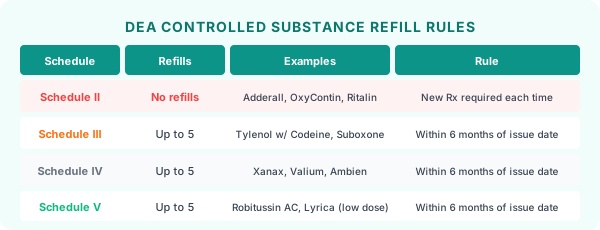
If you take a controlled substance and have ever been told "you need a new prescription every month," you've encountered the DEA's scheduling system. Federal law — specifically the Controlled Substances Act — sets strict rules on how pharmacies can dispense these medications. Understanding which schedule applies to your medication, and what that means for refills, makes managing your prescription significantly less frustrating.
Note: The [prescription refill calculator](/prescription-refill-calculator) calculates standard refill dates and days supply for all medications, but controlled substance refill authorizations are determined by your prescriber and pharmacist based on federal and state law.
How the DEA Scheduling System Works
The Drug Enforcement Administration (DEA) classifies controlled substances into five schedules based on medical use and abuse potential:
- **Schedule I:** High abuse potential, no accepted medical use (heroin, LSD). Never prescribed.
- **Schedule II:** High abuse potential, accepted medical use with severe restrictions.
- **Schedule III:** Moderate abuse potential, accepted medical use.
- **Schedule IV:** Lower abuse potential, accepted medical use.
- **Schedule V:** Lowest controlled abuse potential, accepted medical use.
Most patients interact with Schedules II through IV. Your refill rules depend entirely on which schedule your medication falls under.
Schedule II: No Refills, Ever
This is the most restrictive class. Under the Controlled Substances Act, Schedule II prescriptions cannot be refilled. Period. A new prescription is required every time — no exceptions at the federal level.
**Common Schedule II medications:**
- Stimulants: Adderall (amphetamine), Ritalin/Concerta (methylphenidate), Vyvanse (lisdexamfetamine)
- Opioids: OxyContin/oxycodone, Vicodin (hydrocodone products over 90 mg), fentanyl patches, morphine
- Other: Cocaine (topical medical use), methamphetamine (Desoxyn — rarely prescribed)
**What this means practically:**
- Your prescriber must write a new prescription for each fill.
- Most states now require Schedule II prescriptions to be transmitted electronically (e-prescribing). Paper prescriptions are phased out in most states.
- Your prescriber can provide multiple post-dated prescriptions at one appointment in some states, but not all.
- Fill your prescription within a certain number of days of the written date (varies by state, typically 30-90 days).
**For patients on monthly ADHD medications:** This is why your psychiatrist or primary care doctor sends a new prescription every single month. There's no workaround — it's federal law. Plan your appointments so you leave with your next prescription before you run out.
Schedule III: Up to 5 Refills in 6 Months
Schedule III prescriptions are significantly less restrictive. Federal law allows:
- Up to **5 refills** on a single prescription
- Refills must be used within **6 months** of the original prescription date
After either 5 refills or 6 months — whichever comes first — a new prescription is required.
**Common Schedule III medications:**
- Buprenorphine/naloxone (Suboxone) for opioid use disorder
- Tylenol with Codeine (acetaminophen/codeine) — codeine combinations
- Anabolic steroids (testosterone injections, when prescribed)
- Ketamine (compounded products for depression)
- Certain barbiturate combinations
For patients on Suboxone specifically: you can receive up to 5 refills but your prescriber must be a DATA-waived provider (an X-waiver physician) and you'll have regular monitoring visits regardless of refill availability.
The [early refill rules](/blog/early-refill-rules) (80% rule) still apply to Schedule III medications — your insurance won't cover a refill before 80% of the current supply is used, even if the prescription authorizes refills.
Schedule IV: Up to 5 Refills in 6 Months
The same rules as Schedule III apply — up to 5 refills within 6 months.
**Common Schedule IV medications:**
- Benzodiazepines: Xanax (alprazolam), Valium (diazepam), Klonopin (clonazepam), Ativan (lorazepam)
- Sleep medications: Ambien (zolpidem), Lunesta (eszopiclone), Sonata (zaleplon)
- Stimulants (lower potential): Provigil/Nuvigil (modafinil/armodafinil)
- Tramadol (Ultram)
- Carisoprodol (Soma)
Benzodiazepines are among the most commonly prescribed Schedule IV drugs. Patients on daily anxiety or sleep medications should track refill authorizations carefully — running out on a Friday means waiting until Monday when offices reopen.
After 6 months, you'll need a new prescription regardless of remaining authorized refills. Many prescribers set standing appointments at 6-month intervals specifically for this reason.
Schedule V: Up to 5 Refills in 6 Months
The least restrictive scheduled class, Schedule V follows the same refill rules.
**Common Schedule V medications:**
- Cough preparations with small amounts of codeine (Robitussin AC, Phenergan with Codeine)
- Pregabalin (Lyrica) for nerve pain and fibromyalgia
- Lacosamide (Vimpat) for epilepsy
- Ezogabine (Potiga) for epilepsy
Some Schedule V drugs can be dispensed without a prescription in small quantities in certain states, though this varies by state pharmacy law.
State Law Adds Another Layer
Federal law sets the floor, but states can — and often do — impose stricter requirements. Examples:
- **Electronic prescribing mandates:** Most states now require e-prescribing for controlled substances. New York, Connecticut, and Minnesota were early adopters; most states have followed.
- **PDMP checks:** Prescribers and pharmacists in most states must check the Prescription Drug Monitoring Program (PDMP) database before prescribing or dispensing controlled substances.
- **Shorter prescription windows:** Some states limit Schedule II prescriptions to a 30-day supply regardless of the federal allowance.
- **Partial fills:** Federal law now allows partial fills of Schedule II prescriptions in some circumstances — useful if the full quantity is temporarily unavailable.
The National Association of Boards of Pharmacy (NABP) publishes state-specific pharmacy practice act summaries. For your state's specific rules, check the NABP or your state board of pharmacy website.
Practical Tips for Controlled Substance Patients
**Schedule refill appointments proactively.** For Schedule II medications, don't wait until you're out of medication to schedule the appointment to get your next prescription. Your prescriber's calendar may be full 2-4 weeks out.
**Know your PDMP status.** When pharmacies and prescribers check the PDMP, unusual patterns (filling the same Schedule II at multiple pharmacies, overlapping prescriptions) trigger reviews. Transparency with your prescriber about your medication history is both legally protective and clinically important.
**Travel requires extra planning.** Crossing state lines or international borders with controlled substances requires specific documentation. Our [guide to traveling with medications](/blog/travel-medication-supply) covers what you need for domestic and international travel.
**Emergency supplies are not available.** Unlike non-controlled medications, pharmacists generally cannot dispense emergency supplies of Schedule II or III medications when refills run out. Plan ahead. See [what to do when refills run out](/blog/run-out-of-refills) for non-controlled substance options.