Early Prescription Refill Rules: What the 80% Rule Means
The 80% refill rule determines when insurance will cover your next prescription. Here's exactly how it works, why pharmacies reject early refills, and how to avoid rejections.
> **Quick Answer:** Most insurance plans allow refills when 80% of your current supply has been used. For a 30-day supply, that's day 24. Submit before then and your claim is rejected as "refill too soon."
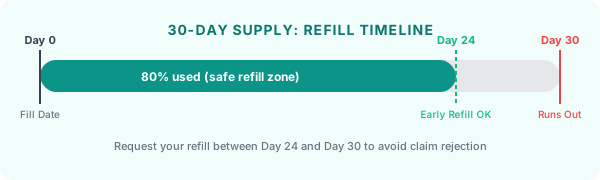
You head to the pharmacy a few days early to refill your blood pressure medication. The pharmacist processes your insurance card, and a minute later: "I'm sorry, your insurance won't cover this yet."
That's the 80% rule in action. It's one of the most frustrating things patients encounter at the pharmacy, but it exists for real reasons — and once you understand it, you can work around it without ever getting rejected again.
What the 80% Rule Actually Is
The 80% rule is the minimum fill threshold used by most pharmacy benefit managers (PBMs) and insurance plans when processing refill claims. Before coverage kicks in, your insurer checks whether 80% of your current supply has been dispensed — meaning you theoretically have 20% remaining.
The rule is sometimes called the **refill-too-soon edit** or the **days supply limit edit**. It's an automated check in the pharmacy claims adjudication system that runs every time a refill claim is submitted.
The Centers for Medicare & Medicaid Services (CMS) uses this threshold for Medicare Part D coverage. Most commercial insurers follow the same standard, though some use 75% instead of 80%. [Check your plan's pharmacy benefits document](/about) or call member services to confirm the threshold your plan uses.
Use the [prescription refill calculator](/prescription-refill-calculator) to find your exact early refill date before heading to the pharmacy.
Calculating Your Early Refill Date
The math is straightforward once you have your days supply:
**Early Refill Date = Fill Date + (Days Supply × 0.80)**
For common supply lengths:
| Days Supply | 80% Date | 75% Date |
|-------------|----------|----------|
| 30 days | Day 24 | Day 22.5 (rounds to Day 23) |
| 45 days | Day 36 | Day 33.75 (Day 34) |
| 60 days | Day 48 | Day 45 |
| 90 days | Day 72 | Day 67.5 (Day 68) |
If you filled a 30-day supply on April 1st, your earliest insurance-covered refill date is April 25th (day 24). Your supply technically runs out on May 1st — so you have a 6-day refill window.
Why the 80% Rule Exists
The rule isn't there to be difficult. It serves two purposes:
**1. Prevents drug stockpiling.** For controlled substances especially, early refills create the possibility of accumulating medication beyond what the current prescription authorizes. The DEA and state pharmacy boards take this seriously.
**2. Controls plan costs.** If every patient refilled at 50% of their supply, plans would pay for nearly twice the medication per year. The 80% threshold ensures plans cover roughly the correct annual supply.
For non-controlled medications, the rule is more administrative than safety-focused. But it applies uniformly across your plan's formulary regardless.
When You Can Override the 80% Rule
Insurance plans do provide override mechanisms for legitimate situations:
**Vacation/travel override.** If you're traveling and will be away during your refill window, call member services and explain the situation. Most plans allow a one-time vacation override per year, which lets the pharmacist dispense a 30-90 day supply early. You typically need to call at least 2-3 business days before departure.
**Lost or stolen medication.** If your prescription was lost or stolen, report it to your pharmacy and call your insurer. They'll often authorize an early refill with proper documentation.
**Dose change.** If your prescriber increased your dose and you ran through your supply faster than expected, the pharmacy can document the dose change and submit a manual override request to your insurer.
**Natural disaster.** FEMA declarations and state emergency orders sometimes trigger automatic coverage of early refills in affected areas.
Our [guide on insurance refill restrictions](/blog/insurance-refill-restrictions) covers each override type in detail.
"Refill Too Soon" vs. Other Rejection Codes
The 80% rejection is often labeled differently on pharmacy systems depending on the PBM:
- **Reject Code 79:** Refill too soon (most common NCPDP code)
- **Reject Code 76:** Plan limitations exceeded
- **"Days supply exceeds plan limit":** Quantity limit, not a timing issue
If you get rejected for a reason other than code 79, the solution is different. Quantity limits require prior authorization from your prescriber. Step therapy requirements mean your plan wants you to try a different (usually cheaper) medication first. [Understanding your insurance plan's refill restrictions](/blog/insurance-refill-restrictions) helps you identify which type of rejection you're dealing with and how to resolve it.
What Happens If You Pay Cash Instead?
Here's something many patients don't know: the 80% rule only applies to insurance claims. If you pay cash — or use a prescription discount card like GoodRx, RxSaver, or NeedyMeds — the pharmacy can dispense a refill at any time, regardless of how much supply you have remaining.
For generic medications, cash prices with a discount card are sometimes lower than your insurance copay. A 30-day supply of generic metformin at many pharmacies costs $4-$10 cash. If your copay is $15, it's worth checking.
This is particularly useful for patients who want to get ahead on a refill before a trip — pay cash this month, then use insurance for the next regular refill.
Controlled Substances and the 80% Rule
Controlled substances have additional restrictions on top of the standard 80% rule. The specifics depend on the schedule:
- **Schedule II** (Adderall, OxyContin): No refills permitted. A new prescription is required each time. Most states require electronic prescribing (e-prescribing) for Schedule II.
- **Schedule III, IV, V**: Up to 5 refills allowed within 6 months of the original prescription date. The 80% rule still applies for timing.
For state-specific rules on controlled substances, the [NABP's state pharmacy practice laws database](https://nabp.pharmacy) is the authoritative reference. Read our full guide on [controlled substance refill rules](/blog/controlled-substance-refills) for a detailed breakdown.
Staying Ahead of Your Refill Window
The best way to never get rejected for "refill too soon" is to know your early refill date before you go to the pharmacy. [Calculate your next refill date](/prescription-refill-calculator) by entering your fill date, quantity, and dosing schedule — the tool shows both your standard refill date and the 80% early refill window.
Set a calendar reminder for your early refill date, not your last day of supply. That 6-8 day buffer between the earliest covered date and your run-out date is your safety net. Use it.