Insurance Prescription Refill Restrictions Explained
Refill too soon, quantity limits, step therapy, prior authorization — these are the four main insurance restrictions that block prescription refills. Here's what each means and how to handle them.
> **Quick Answer:** There are four main insurance-based refill restrictions: refill too soon (timing), quantity limits (monthly cap), step therapy (must try alternatives first), and prior authorization (plan approval required). Each has a different resolution process.
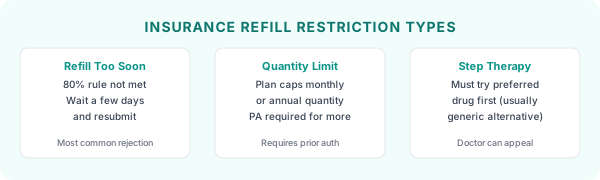
Your insurance plan doesn't just pay for your medications — it actively controls when and how you can get them. Pharmacy benefit managers (PBMs) process every claim in real time, running automated checks that can reject a refill before you even reach the counter. Knowing which check is blocking you makes the difference between a 10-minute fix and a week-long delay.
Use the [prescription refill calculator](/prescription-refill-calculator) to check whether a timing issue is the culprit before calling your insurance company.
Restriction 1: Refill Too Soon
This is the most common rejection. Your plan's system checks whether 80% (sometimes 75%) of your current supply has been used. If you're requesting a refill before that threshold, the claim is rejected with code 79: "Refill Too Soon."
**Resolution:** Wait until the 80% mark and resubmit. The [prescription refill calculator](/prescription-refill-calculator) shows your exact early refill eligible date — check this before going to the pharmacy.
**Override options:**
- **Vacation override:** One-time per year, allows early fill for travel. Call member services with your travel dates.
- **Lost/stolen:** Pharmacist can submit an override with documentation.
- **Pay cash:** The refill-too-soon rule only applies to insurance claims. Pay out of pocket using a discount card, then use insurance normally for the next fill.
Restriction 2: Quantity Limit (QL)
Quantity limits cap how much medication your plan will cover per month or per year. They're most common on:
- Controlled substances (especially opioids and benzodiazepines)
- Migraine medications (triptans — often limited to 9 tablets per 30 days)
- Injectable biologics
- Erectile dysfunction medications
- Sleep aids (especially higher-dose formulations)
**Why it exists:** Cost control and appropriate use management. A plan that limits sumatriptan to 9 tablets per month is enforcing evidence-based prescribing guidelines for migraine treatment.
**Resolution:**
- If your prescriber believes you need more than the quantity limit allows, they can submit a **prior authorization (PA)** request explaining the medical necessity.
- Your prescriber's office typically handles this — ask them to submit a PA specifically for a quantity limit exception.
- PAs can take 1-5 business days. Your plan must respond within 72 hours for non-urgent situations under federal law (24 hours for urgent situations).
**What to say to your pharmacist:** "Can you tell me what the quantity limit is for this medication, and who I need to contact to request a prior authorization?"
Restriction 3: Step Therapy (Fail First)
Step therapy requires you to try a preferred medication (usually a generic or lower-tier drug) before your plan will cover a more expensive alternative. It's called "fail first" because you must document that the preferred option didn't work for you.
**Common examples:**
- Your prescriber writes for Nexium (esomeprazole brand) but your plan requires you to try generic omeprazole first.
- You're prescribed a newer brand-name antidepressant but the plan requires generic SSRIs first.
- A biologic like Humira is prescribed but the plan requires conventional DMARDs first for rheumatoid arthritis.
**Resolution:**
Your prescriber can submit a step therapy exception request if:
- You already tried the preferred medication and it didn't work.
- The preferred medication is medically contraindicated for you.
- The preferred medication would cause adverse effects based on your history.
As of 2023, federal law (the SUPPORT for Patients and Communities Act) and many state laws restrict insurers from requiring step therapy in certain clinical situations and mandate timely responses to exception requests.
**Important:** If you've already tried the preferred medication in the past — even years ago with a different insurer — document that history and provide it to your prescriber for the exception request.
Restriction 4: Prior Authorization (PA)
Prior authorization is the broadest category. Your plan requires your prescriber to document medical necessity before covering specific medications. PAs are required on:
- Many brand-name medications (especially when generics exist)
- Specialty drugs (biologics, cancer medications, certain high-cost drugs)
- Off-label uses
- High-dose formulations
- Certain drug combinations that raise safety concerns
**The PA process:**
1. The pharmacy submits your claim.
2. The plan rejects it with a code indicating PA is required.
3. The pharmacist notifies you and sometimes contacts your prescriber's office directly.
4. Your prescriber's office submits a PA request with clinical documentation.
5. The plan reviews and approves or denies the PA (1-5 business days, sometimes longer for specialty drugs).
6. If approved, you fill the prescription. If denied, you appeal.
**Expedite a PA:**
Ask your prescriber to mark the PA request "urgent" if you're running out of medication. Urgent PAs must be processed within 24 hours under federal law.
**PA denial and appeals:**
If a PA is denied, you have the right to appeal. First-level appeals are reviewed by the plan's medical director — success rates improve significantly if your prescriber provides additional clinical documentation. If the plan-level appeal fails, you can request an external independent review.
Restriction 5: Formulary Exclusions
Some medications are simply excluded from your plan's formulary — they don't appear at any tier. This is different from a PA requirement; a formulary exclusion means the plan won't cover the drug under any circumstances without an exception.
Formulary exclusions are most common for brand-name medications where an equivalent generic exists. Your plan may exclude brand Lipitor entirely because generic atorvastatin is available and therapeutically equivalent.
**Resolution:**
- Ask your prescriber to prescribe the generic equivalent.
- If no equivalent exists, your prescriber can request a non-formulary exception (similar to a PA), arguing that the excluded medication is medically necessary and alternatives are inadequate.
Navigating Restrictions Efficiently
The most important person in resolving a refill restriction is your prescriber's office — specifically whoever handles prior authorizations (often a nurse or medical assistant). Give them as much lead time as possible.
If you're consistently having restriction issues with a specific medication, ask your prescriber at your next appointment whether there's a formulary-friendly alternative that would work clinically. Most prescribers are willing to optimize for formulary coverage when there's genuine clinical equivalence.
[Check your early refill date](/prescription-refill-calculator) before every pharmacy trip to rule out a simple timing issue — it's the most common and easiest restriction to avoid.
See also our guides on [insurance cost savings strategies](/blog/medication-cost-savings) and [what to do when refills run out](/blog/run-out-of-refills) for related troubleshooting.