7 Ways to Cut Your Prescription Refill Costs
From switching to generics to using the 340B program, these seven strategies reduce what you pay per fill — some by 80% or more.
> **Quick Answer:** The biggest cost lever for most patients is switching to generic equivalents — savings average 80-85% versus brand name. Combining a generic switch with a 90-day supply and mail-order delivery can cut annual medication costs by $300–$800 for a typical maintenance medication.
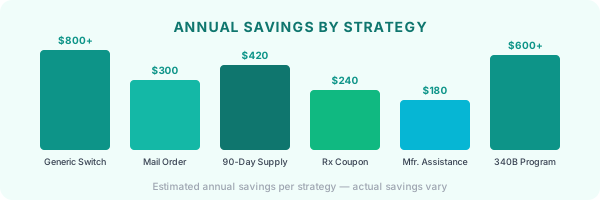
Prescription drug costs have risen faster than inflation for the past decade. But for most patients on maintenance medications, there's significant money being left on the table — in the form of generic equivalents, supply length optimizations, and assistance programs they've never been told about.
Use the [prescription refill calculator](/prescription-refill-calculator) to project your annual medication cost before applying these strategies, then recalculate after to see the difference.
Strategy 1: Switch to a Generic
Generic medications contain the same active ingredient, in the same dose, with the same bioavailability as brand-name drugs. They're required by FDA standards to be therapeutically equivalent. The only differences are inactive ingredients (fillers, coatings) and price.
The average brand-name drug costs $339 per fill. The average generic equivalent costs $44. That's an **87% reduction** for the same medication.
**How to make the switch:**
- Ask your pharmacist whether a generic equivalent exists for your medication. For most established drugs, it does.
- If your prescription specifies the brand name, ask your prescriber to change it to "generic acceptable" or simply write the generic name.
- Some patients have legitimate reasons to stay on brand (known sensitivity to fillers in a specific generic manufacturer, narrow therapeutic index medications like levothyroxine or warfarin where switching between manufacturers can cause variation). Discuss with your prescriber if you have concerns.
**Narrow therapeutic index warning:** For warfarin (Coumadin), levothyroxine (Synthroid), anti-epileptics, and certain other medications, switching between manufacturers — even between different generics — can sometimes cause clinically meaningful differences in blood levels. If you're on one of these, don't switch without discussing it with your prescriber.
Strategy 2: Switch to a 90-Day Supply
[The 90-day supply comparison guide](/blog/90-day-supply-benefits) covers this in detail, but the short version: most maintenance medications cost less per day on a 90-day schedule than on monthly fills.
For a medication with a $15 copay per 30-day fill and $35 copay per 90-day fill:
- Monthly: 12 × $15 = $180/year
- 90-day: 4 × $35 = **$140/year** (saves $40)
The savings compound across multiple medications. If you take four maintenance drugs and each saves $40-$60 per year on 90-day fills, that's $160-$240 annually without changing a single medication.
Strategy 3: Use Prescription Discount Cards
GoodRx, RxSaver, NeedyMeds, Blink Health, and similar services negotiate discounted cash prices with pharmacies. These prices are often lower than insurance copays for generic medications.
**A real-world example (April 2026, national averages):**
- Atorvastatin 20 mg (30 tablets): Insurance copay often $10-$25 for generic. GoodRx price at major chains: $4-$12.
- Metformin 1000 mg (60 tablets): Insurance copay often $10-$20. GoodRx: $4-$8.
**How to use them:**
1. Search your medication on GoodRx.com or the GoodRx app.
2. Compare prices across pharmacies near you.
3. Show the discount code to the pharmacy — you pay cash, not insurance.
Important: When you use a discount card, the transaction doesn't count toward your deductible or out-of-pocket maximum. If you're trying to reach your deductible, paying with insurance may be strategically better even if the cash price is lower.
Strategy 4: Mail-Order Pharmacy
If you're on a 90-day supply already, consider mail-order delivery. Major pharmacy benefit managers' mail-order services (Express Scripts, OptumRx, CVS Caremark) often have the lowest copays for 90-day fills.
A plan that charges $35 at retail for 90 days might charge $25 through their mail-order service. Over a year, that's $10 savings × 4 fills = $40 per medication. Multiply by four maintenance drugs: $160/year.
Mail-order requires planning ahead — typically 7-10 days for standard delivery. Set a reminder based on your [early refill date](/prescription-refill-calculator) to order before you're running low.
Strategy 5: Manufacturer Patient Assistance Programs
For brand-name medications with no generic alternative, the manufacturer often has a patient assistance program (PAP) or copay card. These can reduce or eliminate your out-of-pocket cost.
**Two types:**
- **Copay assistance cards:** Manufacturer pays a portion of your copay (e.g., "Pay no more than $10 per fill for up to 12 fills"). Available through the manufacturer's website or NeedyMeds.org.
- **Free medication programs:** For patients who can't afford the medication at all, manufacturers sometimes provide the drug free of charge. Income requirements apply — typically below 200-400% of the federal poverty level.
**How to find programs:**
- NeedyMeds.org covers nearly every patient assistance program.
- RxAssist.org covers thousands of assistance programs by drug name.
- The manufacturer's website (usually under "Support" or "Assistance").
Copay cards typically don't work for patients on Medicaid or Medicare — federal anti-kickback rules prohibit using manufacturer coupons to reduce government-insured patient cost-sharing.
Strategy 6: The 340B Drug Pricing Program
The 340B program requires pharmaceutical manufacturers to sell drugs at significantly reduced prices to qualified healthcare organizations — primarily federally qualified health centers (FQHCs), certain hospitals, and safety-net providers.
If you receive care at one of these organizations, you may be eligible to have your prescriptions filled through their pharmacy at 340B prices, which can be 25-50% lower than standard wholesale prices.
To check eligibility:
- Ask your healthcare provider whether they're a 340B covered entity.
- See if they have an in-house pharmacy or a contracted external pharmacy participating in the 340B program.
- HRSA (Health Resources and Services Administration) maintains a public database of 340B-covered entities.
This strategy has the most variability — it depends entirely on where you receive care — but for patients at qualifying health centers, the savings can be substantial on both generic and brand medications.
Strategy 7: Therapeutic Substitution
If your prescriber has you on a brand-name medication in a drug class that has multiple equivalent generics, ask about switching to a generic within the same class.
**Example:** You're prescribed Crestor (rosuvastatin, still partially brand-dominant) for cholesterol. Generic rosuvastatin is available and much cheaper, but so is generic atorvastatin (Lipitor). Both are statins; your prescriber can assess whether atorvastatin is an appropriate substitute based on your cholesterol profile.
This requires a prescriber conversation — you can't just substitute drug classes on your own. But for stable, well-controlled chronic conditions, many prescribers are happy to consider formulary-friendly alternatives.
Combining Strategies for Maximum Savings
The biggest wins come from combining strategies. Generic + 90-day supply + mail-order can reduce the cost of a single maintenance medication from $600/year (brand, monthly, retail) to $140-$200/year (generic, quarterly, mail-order). That's a reduction of $400+ annually on one drug.
Calculate your current annual spend using the [prescription refill calculator](/prescription-refill-calculator), then work through these seven strategies systematically. Most patients find at least 2-3 that apply to their situation. Our [guide to managing maintenance medications](/blog/maintenance-medication-tips) includes a worksheet for tracking your medications and applied savings strategies.