How to Calculate Days Supply for Any Prescription
Learn the days supply formula pharmacists use, with worked examples for once-daily, twice-daily, and multi-tablet dosing schedules.
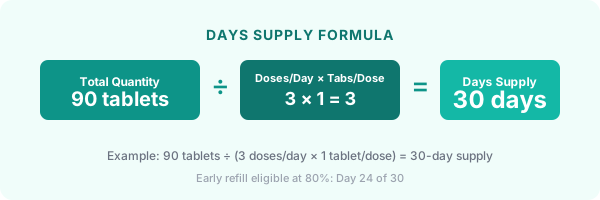
> **Quick Answer:** Days supply = Total quantity ÷ (doses per day × tablets per dose). A 90-tablet prescription taken three times daily (one tablet each time) gives you a 30-day supply.
Days supply is the number your pharmacist enters when submitting an insurance claim — and it's one number that drives every refill date calculation you'll ever do. Get it wrong and you end up at the pharmacy counter too early, or you run out of medication before your next refill is covered.
This guide walks through the formula, common scenarios, and the mistakes that trip up patients most often.
The Core Formula
The days supply calculation is simple:
**Days Supply = Total Quantity ÷ (Doses Per Day × Tablets Per Dose)**
Every pharmacy uses this formula. It's the same one your insurer uses when evaluating whether a refill claim is "too soon." The National Council for Prescription Drug Programs (NCPDP) standardized this calculation across the industry — so it doesn't matter whether you're filling at a chain pharmacy or an independent.
You need three numbers from your prescription label:
Use our [prescription refill calculator](/prescription-refill-calculator) to run these numbers and get your refill date in seconds.
Worked Examples
Example 1: Once-Daily Medication (Simplest Case)
You fill a prescription for atorvastatin (a cholesterol statin). The label shows:
- Qty: 30 tablets
- Take 1 tablet daily
Days supply = 30 ÷ (1 × 1) = **30 days**
Your next refill date is 30 days after your fill date. Straightforward.
Example 2: Twice-Daily Medication
You fill metformin for type 2 diabetes:
- Qty: 60 tablets
- Take 1 tablet twice daily (morning and evening)
Days supply = 60 ÷ (2 × 1) = **30 days**
Still 30 days — but now you've used twice the tablets. A 90-tablet fill at this dose would give you 45 days.
Example 3: Multi-Tablet Dosing
Your antibiotic is 500 mg per dose, dispensed as 250 mg tablets:
- Qty: 28 tablets
- Take 2 tablets twice daily
Days supply = 28 ÷ (2 × 2) = **7 days**
This is where patients get tripped up. If you only enter "2 doses per day" and forget the "2 tablets per dose," you'd calculate 14 days instead of 7 — and potentially face a refill rejection when your actual supply runs out after a week.
Example 4: Three Times Daily
You're on amoxicillin for an infection:
- Qty: 30 capsules
- Take 1 capsule three times daily
Days supply = 30 ÷ (3 × 1) = **10 days**
Your supply is gone in 10 days. The prescription is a short course, not a maintenance medication.
Why the Days Supply Number Matters
Your insurance plan uses your days supply to calculate the date it will cover your next refill. Most plans apply the **80% rule**: you can refill when 80% of your current supply has been used, meaning 20% is theoretically still remaining.
For a 30-day supply, that's day 24. For a 90-day supply, that's day 72. Submit before that window and the claim rejects with a "refill too soon" error.
The [early refill rules guide](/blog/early-refill-rules) explains how this works in practice — including what to do when your plan uses 75% instead of 80%.
Common Calculation Mistakes
**Mistake 1: Confusing quantity with days supply**
A bottle labeled "Qty: 90" doesn't mean 90 days. That's 90 tablets. Whether it's a 30-day, 45-day, or 90-day supply depends entirely on your dosing schedule.
**Mistake 2: Ignoring the tablets-per-dose field**
Most patients take one tablet per dose, so this defaults to 1 in most calculators and pharmacy systems. But if your prescription says "take 2 tablets," you must enter 2 — otherwise your days supply calculation doubles what it should be.
**Mistake 3: Using the labeled days supply without checking**
Pharmacy systems sometimes record the days supply based on the prescription instructions. If those instructions are ambiguous or the pharmacy entered them wrong, your days supply might be off by a few days. When in doubt, [run the calculation yourself](/prescription-refill-calculator) and compare it to what's on your bottle.
**Mistake 4: Not accounting for dose changes**
If your prescriber changed your dose mid-supply — say, from 1 tablet daily to 2 tablets daily — your remaining days supply is now half what it was. The calculator assumes a consistent dose throughout the supply period.
Liquid Medications and Inhalers
The same formula applies to liquids and inhalers, just with different units:
**Liquid:** Daily dose in mL ÷ total mL dispensed = days supply
- 10 mL liquid amoxicillin suspension, 5 mL twice daily: 10 ÷ (2 × 5) = **1 day** (short course antibiotics come in small volumes)
- 240 mL bottle, 15 mL once daily: 240 ÷ (1 × 15) = **16 days**
**Inhaler:** Total actuations ÷ actuations per day = days supply
- 200-actuation inhaler, 2 puffs twice daily: 200 ÷ (2 × 2) = **50 days**
The pharmacy's dispensing system handles these calculations automatically, but knowing the formula helps you verify your refill schedule and avoid unexpected shortages.
The 90-Day Supply Advantage
Once you understand how days supply works, it's easy to see why [90-day supplies save money and trips to the pharmacy](/blog/90-day-supply-benefits). The math stays the same — you just fill four times per year instead of 12.
For maintenance medications like blood pressure drugs, statins, thyroid medications, and diabetes drugs, ask your prescriber to write for a 90-day supply. Most insurance plans cover this for maintenance medications, and mail-order pharmacies often offer further discounts on top.
Tracking Multiple Prescriptions
If you're managing more than one medication, keeping the days supply and refill dates organized prevents gaps. Our [guide to tracking multiple prescriptions](/blog/multiple-medication-tracking) covers a simple system that works even for patients on six or more medications.
Ready to calculate your exact refill date? [Use the prescription refill calculator](/prescription-refill-calculator) — enter your fill date, quantity, and dosing schedule and get your next refill date, early refill window, and annual cost estimate instantly.