What to Do When You Run Out of Prescription Refills
Your last refill is gone and your doctor isn't available. Here are four practical options, ranked by speed and reliability, for getting your medication refilled fast.
> **Quick Answer:** Contact your prescriber first — they can send a new prescription electronically, often same-day. If unreachable, ask your pharmacist about an emergency supply, use a telehealth service, or pay cash while waiting for authorization.
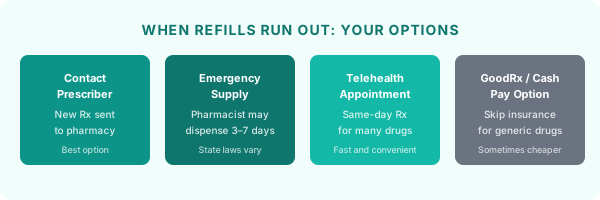
Running out of authorized refills is different from running out of medication. Your prescription hasn't been discontinued — you just need your prescriber to authorize more before the pharmacy can dispense again.
How urgent this is depends on the medication. Missing two days of a statin probably won't cause harm. Missing two days of insulin or a blood thinner is a different situation. Know where your medication falls on that spectrum and act accordingly.
Use the [prescription refill calculator](/prescription-refill-calculator) to track remaining refills before you hit zero — the calculator shows your remaining refill count when you enter total refills allowed and refills used.
Option 1: Contact Your Prescriber Directly (Best First Step)
Your prescribing provider — whether that's your primary care doctor, specialist, cardiologist, endocrinologist, or nurse practitioner — can send a new prescription to your pharmacy electronically within minutes.
**How to reach them quickly:**
- Use the patient portal message system. Most practices monitor these throughout the day.
- Call and ask for a prescription refill specifically — the front desk often routes these requests to a nurse without requiring an appointment.
- If calling, have your pharmacy's phone number and fax number ready. Electronic prescribing is now standard, but some practices still fax.
Most practices handle straightforward refill requests for stable, established medications within 24-48 hours. If you're calling on a Friday afternoon, expect Monday.
**What to say:** "I've used my last authorized refill on [medication name and dose]. I'd like to request a new prescription for [30 or 90 days]. My pharmacy is [name] and the number is [phone]."
Option 2: Ask for an Emergency Supply at the Pharmacy
If your prescriber is unavailable — over a holiday weekend, during after-hours, on vacation — many pharmacists can dispense a short emergency supply of your medication. This is typically 3-7 days, enough to bridge the gap until your prescriber is reachable.
**State laws vary significantly here.** As of 2026:
- Most states allow emergency dispensing for maintenance medications (blood pressure, diabetes, thyroid) when the prescriber is unavailable and the patient's health could be at risk without the medication.
- Some states restrict this to 72 hours; others allow up to 30 days.
- Controlled substances are generally excluded from emergency dispensing provisions.
Ask your pharmacist specifically: "Can you dispense an emergency supply while I contact my prescriber?" If your regular pharmacy can't, try a different pharmacy — policies differ by chain and state.
Your insurer may not cover an emergency supply, so you might pay out of pocket. For generic medications, this is typically $4-$20 for a few days' supply. Worth it to avoid a treatment gap.
Option 3: Use a Telehealth Service
Telehealth has made same-day prescriptions routine for many maintenance medications. Services like Teladoc, MDLive, Doctor on Demand, and newer platforms like Ro, Hims, and Cerebral can connect you with a licensed provider who can write a new prescription — often within a few hours.
**This works best for:**
- Stable maintenance medications you've been on long-term (blood pressure meds, thyroid, statins, common mental health medications)
- Situations where your regular doctor's office is closed or has a 2-week wait for appointments
- States where prescribing via telemedicine for common conditions is well-established
**Limitations:** Telehealth providers generally won't prescribe controlled substances for new patients. For schedule II medications (stimulants, certain opioids), you'll need your established prescriber or an in-person appointment.
Cost is typically $50-$100 for a telehealth visit. Check whether your insurance covers telehealth visits — many plans now cover them at the same rate as in-person primary care.
Option 4: Pay Cash Using a Discount Card
If you simply need a few extra days of a generic medication while you wait for your prescriber to respond, paying cash with a discount card is often faster than any other option.
GoodRx, RxSaver, NeedyMeds, and similar services provide coupons that reduce the cost of generic medications dramatically at most pharmacies. Unlike insurance claims, cash transactions don't require authorization, refill timing checks, or the 80% rule to be satisfied.
**Typical cash prices for common generics with a discount card:**
- Lisinopril 10 mg (30 tablets): $4-$9
- Metformin 500 mg (60 tablets): $4-$10
- Atorvastatin 20 mg (30 tablets): $10-$18
- Levothyroxine 50 mcg (30 tablets): $8-$15
- Amlodipine 5 mg (30 tablets): $4-$8
Search your medication on GoodRx before assuming your insurance is cheaper. For generic drugs, it sometimes isn't.
What Not to Do
**Don't split or skip doses to stretch supply.** This is tempting but dangerous for medications where consistent blood levels matter — anticoagulants, antiepileptics, antidepressants, blood pressure medications. Talk to your pharmacist before altering your dose.
**Don't borrow from someone else's prescription.** Even well-intentioned sharing of prescription medication is illegal and can be dangerous if the medication or dose isn't the same.
**Don't wait until you've completely run out.** The [prescription refill calculator](/prescription-refill-calculator) shows your remaining refill count alongside your refill date. If you see "0 refills remaining" with less than 14 days of supply left, that's your cue to contact your prescriber now — not when the bottle is empty.
Long-Term Fix: Track Refills Before They Run Out
The real solution is proactive tracking. At your next appointment, confirm how many total refills are authorized and when the prescription expires. Prescriptions for non-controlled substances typically have a 1-year expiration from the date written. After that, even if refills are remaining on paper, the pharmacy can't fill them without a new prescription.
Our [guide to managing multiple maintenance medications](/blog/maintenance-medication-tips) includes a tracking system you can set up in about 15 minutes that prevents this situation from happening again.