How to Get Enough Medication for International Travel
Planning to travel abroad? Here's how to get a vacation override, what documentation to carry, and how to handle controlled substances at customs without problems.
> **Quick Answer:** Request a vacation override from your insurer at least 2 weeks before departure. Fill to a 90-day supply if possible, carry medications in original labeled bottles, and bring a letter from your prescriber for controlled substances.
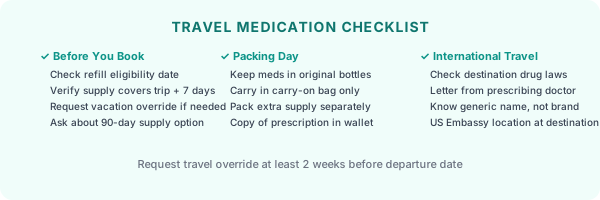
Traveling while on prescription medications requires more planning than most people realize — especially when you're crossing into countries with different pharmacy regulations or time zones that complicate your dosing schedule.
The biggest mistake travelers make is not checking their refill date until a few days before departure. Use the [prescription refill calculator](/prescription-refill-calculator) to check whether your supply covers the entire trip — including a 7-day buffer for delays and unexpected extensions.
Step 1: Calculate How Much Medication You Need
Before anything else, know your numbers. Enter your fill date, quantity, and dosing schedule into the [refill date calculator](/prescription-refill-calculator) to see exactly when your current supply runs out.
Then calculate whether that date clears your return date plus 7 days:
- **Trip from April 10 to April 25 (15 days)**
- **Buffer: 7 days**
- **You need supply through at least May 2**
If your current supply runs out before May 2, you need to either refill early (via vacation override) or get a longer supply before you leave.
Step 2: Request a Vacation Override for Early Refill
Insurance plans typically allow one vacation override per year — a one-time exception to the 80% rule that lets you refill early for travel purposes.
**How to request it:**
1. Call the member services number on the back of your insurance card.
2. Explain that you're traveling internationally and need an early refill.
3. Provide your travel dates.
4. Get a reference number for the authorization.
**Timing:** Request the override at least 10-14 business days before your departure. Some plans require a written request or a call from your prescriber's office.
If your plan won't grant an override, ask your pharmacist — some plans allow pharmacist-initiated overrides for travel with the right documentation.
If your refill date falls right around your departure, you may not need an override at all. [Check your exact early refill date](/prescription-refill-calculator) — if the 80% window opens before you leave, you can fill normally.
Step 3: Consider Switching to a 90-Day Supply
If you're on a maintenance medication (blood pressure, thyroid, diabetes, cholesterol), now is the perfect time to switch to a 90-day supply. This both ensures you have enough for your trip and reduces how often you need to fill in the future.
Ask your prescriber to write for 90 days. [The 90-day vs. 30-day comparison](/blog/90-day-supply-benefits) shows the cost difference — for most maintenance medications, 90-day fills save money even after accounting for the higher per-fill copay.
What to Carry When You Travel
**Keep medications in original labeled bottles.** This is non-negotiable for customs and border crossing. The label confirms what the medication is, who it's prescribed to, the prescribing doctor, and the pharmacy. Unlabeled medications in generic containers create problems at security checkpoints.
**Carry in your carry-on bag, not checked luggage.** Checked luggage can be lost, delayed, or exposed to extreme temperatures (cargo holds in some aircraft reach below freezing or above 100°F). Medications — especially temperature-sensitive ones like insulin, biologics, or nitroglycerin — should always stay with you.
**Bring extra supply as backup.** Pack your main supply in your carry-on and a few days' backup in your checked bag. If your carry-on is gate-checked or temporarily confiscated, you're not stranded without medication.
**Documentation to carry:**
- Copy of your prescription (for the pharmacist or doctor if you run out abroad)
- Letter from your prescriber on official letterhead listing all medications, doses, and medical necessity
- Insurance card and prescription drug benefit card
- Your prescriber's contact information and after-hours number
Controlled Substances: Special Rules Apply
Traveling with Schedule II–V controlled substances requires extra care.
**Domestic US travel (TSA):** You're permitted to carry your prescribed controlled substances on flights. Keep them in original labeled containers. The TSA doesn't require you to declare medications, but having your prescription label and prescriber's letter available smooths things if you're questioned.
**International travel:** This is where it gets complicated. Many countries classify controlled substances differently from US schedules — a Schedule IV benzodiazepine that's legal in the US may be illegal to import into Japan, the UAE, or certain Southeast Asian countries.
Before international travel with controlled substances:
1. Check the destination country's drug import rules. The best source is the destination country's embassy or customs website.
2. Get a letter from your prescriber specifically stating the medical necessity and that the medication is prescribed in your name.
3. In some countries (Japan is the most notable example), you must apply for an import certificate in advance for certain medications. This process can take 2-4 weeks.
For full details, see our guide on [controlled substance refill rules and scheduling](/blog/controlled-substance-refills) — and cross-reference with your specific destination country's requirements.
Managing Dosing Schedules Across Time Zones
For once-daily medications, crossing time zones is straightforward: take your medication at the same time of day at your destination. Your body clock adjusts within a few days.
For twice-daily or more frequent dosing, maintain roughly 12-hour (or 8-hour for three-times-daily) spacing. Use your phone's local time, not home time, after the first day.
For medications that must be taken with specific timing relative to food, sleep, or other medications (like levothyroxine, which should be taken on an empty stomach 30-60 minutes before eating), discuss the timing adjustment with your prescriber before travel.
**Insulin-dependent diabetes:** Crossing multiple time zones with insulin requires a specific plan. Contact your endocrinologist or diabetes care team before international travel. The American Diabetes Association has published guidelines for insulin dosing during long-haul travel.
What to Do If You Run Out Abroad
Losing medications or running out unexpectedly while abroad is stressful but manageable:
1. **Pharmacies abroad:** Many countries have over-the-counter availability for medications that require a prescription in the US. Pharmacies in Europe, Canada, Mexico, and most developed countries can often help with common medications. Having your prescription label and prescriber's letter helps enormously.
2. **US Embassy or Consulate:** They can help locate English-speaking medical care and, in emergency situations, assist with emergency prescription dispensing.
3. **International travel insurance:** If you have travel insurance with medical coverage, it may cover the cost of replacing medication abroad.
4. **Telemedicine:** Some US-based telehealth services can consult with you remotely and send prescriptions to a pharmacy near your location, depending on the country and the medication.
Ready to check your current supply before your next trip? [Calculate your refill date](/prescription-refill-calculator) and verify your supply covers your departure date plus 7 days of buffer.