Quick Answer
Most pharmacies allow early refills once 80% of your supply is used. Learn when this applies, when it doesn't, and what to do when insurance denies early fills.
You're 23 days into a 30-day supply and you want to refill before a trip. Whether your pharmacy can do it depends on one thing: the 80% rule, and a few exceptions most patients don't know about.
What Is the 80% Rule?
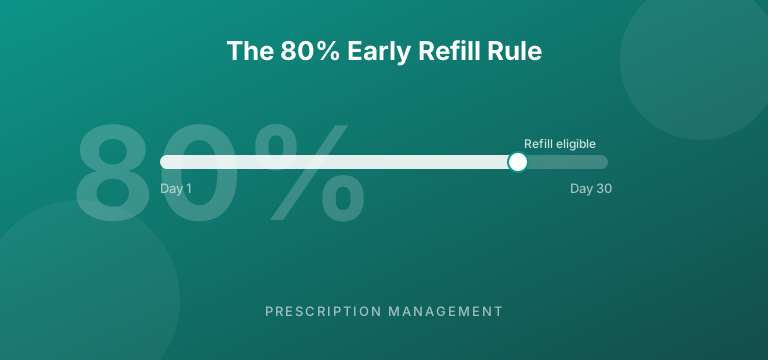
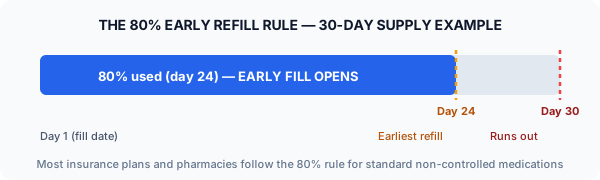
The 80% rule is a standard used by most commercial insurance plans and Medicare Part D to determine when a prescription refill is covered. A refill becomes eligible once the patient has used approximately 80% of the current supply.
For a 30-day supply, that's day 24 (6 days before running out).
For a 90-day supply, that's day 72 (18 days before running out).
This window exists for good reason. It gives patients time to request a refill, account for pharmacy processing time, and avoid gaps in therapy, especially for medications where missing even one dose causes symptoms.
Calculate your exact early fill date with our prescription refill calculator.
Where the 80% Number Comes From
The threshold traces back to CMS (Centers for Medicare & Medicaid Services) guidelines for Part D pharmacy benefits, which set the standard at the 75-80% usage mark. Commercial insurers adopted similar thresholds over time.
The specific percentage can vary:
- Most commercial insurance: 80% (day 24 for a 30-day supply)
- Medicare Part D: Typically 75% (day 22.5 for a 30-day supply), though plans vary
- Medicaid: Varies significantly by state. Some allow refills at 80%, others earlier for certain drug classes
- Cash pay (no insurance): No restriction: pharmacies can fill anytime, but controlled substances still follow DEA rules
Controlled Substances Have Stricter Rules
The 80% rule applies to standard non-controlled medications. Controlled substances, meaning Schedule II through V drugs, follow DEA regulations that are much more restrictive.
Schedule II (e.g., Adderall, oxycodone, fentanyl): No early refills permitted under federal law. A new prescription is required each time, and most states require electronic prescribing for Schedule II drugs. No "rollovers" or early fills under any circumstances.
Schedule III-V (e.g., Tylenol with codeine, Xanax, Ambien): Refills are permitted (up to 5 for Schedule III-IV, 6 months' worth for Schedule V), but early refill restrictions still apply. Many states set their own thresholds stricter than 80%.
If you're on a controlled substance and need an early refill for travel, talk to your prescriber, not the pharmacy. The solution typically involves a separate vacation override authorization, which some insurers provide for out-of-state travel.
How to Know Exactly When Your Refill Opens
The cleanest way is to use a refill date calculator: enter your fill date, tablet count, and daily dose, and it will calculate both your standard refill date and your early eligibility date.
Alternatively, you can calculate it manually:
1. Find your days supply (printed on label)
2. Multiply by 0.2: this is the "buffer" days
3. Subtract the buffer from days supply: this is how many days until early fill opens
Example: 90-day supply × 0.2 = 18 buffer days. 90 - 18 = 72. Your early fill window opens on day 72 after the fill date.
What to Do When Insurance Denies an Early Refill
A denial doesn't always mean no. Here are the legitimate paths around it:
Emergency supply: If you've genuinely lost medication or had an unexpected emergency, pharmacists can dispense an emergency supply (typically 3-7 days) in most states, billed as a partial fill.
Vacation override: Most insurance plans have a process for approving early fills when a patient will be traveling. Call the member services number on your insurance card and ask about "vacation supply" or "early refill override." You'll need to document travel dates.
Prior authorization with clinical justification: For patients with documented adherence issues or clinical conditions requiring uninterrupted therapy, a prior authorization from the prescriber can override early refill restrictions. This is more common for psychiatric medications and anticoagulants.
Pay cash for a bridge supply: If the math works out, sometimes paying out of pocket for a few days' bridge supply is cheaper and faster than navigating insurance. Ask the pharmacist what a cash price looks like for a 7-day supply.
Mail-Order Pharmacies and the 80% Rule
Mail-order pharmacies often have their own timing guidelines on top of insurance requirements. Because mail-order ships 90-day supplies and delivery takes 7-10 days, many mail-order programs allow refills at the 67-75% mark rather than 80%. To ensure the next supply arrives before the current one runs out.
Check your specific mail-order pharmacy's policies, since they vary by insurer and pharmacy network.
Pharmacies Can Refuse Early Refills Even If Insurance Approves
This surprises many patients: even if your insurance has approved an early refill, the dispensing pharmacy can still decline if the pharmacist has concerns about early fill patterns for controlled substances or if state pharmacy board rules are more restrictive than your insurance policy.
Standard non-controlled medications generally don't run into this, but if you're managing a complex medication regimen, it's worth building a relationship with a consistent pharmacist who knows your history.
Track your refill dates accurately with our refill date tool to plan ahead and avoid unnecessary early-fill requests entirely.