Quick Answer
Learn the exact formula pharmacists use to calculate days supply, why it matters for refills, and how to verify your own prescription label.
Your prescription label shows a "days supply" number, but most patients don't know how pharmacists arrive at that figure, or why it matters so much for insurance coverage, early refills, and avoiding gaps in therapy. Here's exactly how it works.
The Days Supply Formula
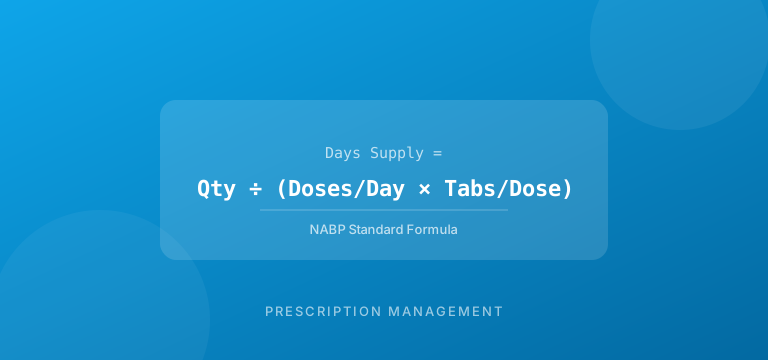
Pharmacists calculate days supply using one formula, standardized by the National Association of Boards of Pharmacy (NABP):
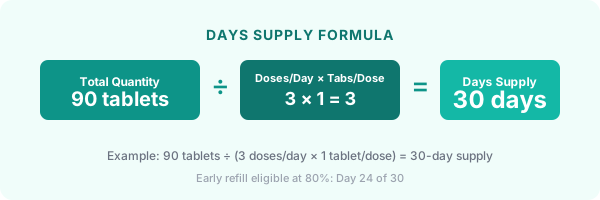
Days Supply = Total Quantity ÷ (Doses Per Day × Tablets Per Dose)
That's it. No estimation, no rounding to the nearest common supply. If your bottle has 45 tablets and you take 1.5 tablets twice daily, your days supply is exactly 15 days, and your insurance won't cover a refill any earlier than that.
A Worked Example
Say your doctor prescribes metoprolol 50mg and instructs you to take 2 tablets twice a day. Your pharmacy dispenses 120 tablets.
- Total quantity: 120 tablets
- Doses per day: 2
- Tablets per dose: 2
- Daily consumption: 2 × 2 = 4 tablets/day
- Days supply: 120 ÷ 4 = 30 days
If they'd dispensed 90 tablets instead, your days supply drops to 22.5 days; which pharmacies typically round down to 22 days. This matters because your insurance won't approve a refill until day 22, not day 30.
Use our prescription refill calculator to run these numbers for your own medication in seconds.
Why Pharmacies Round Down (Not Up)
The NABP Model Act requires pharmacies to use the floor function (round down) when days supply produces a decimal. This prevents insurance overbilling and ensures patients don't run out mid-dose.
Rounding down is also why a 30-tablet supply at 1 tablet/day gives you exactly 30 days, but 29 tablets at the same dosage gives you 29 days, not 30. The number on your label reflects the true last day of supply, not an approximation.
What Happens if the Days Supply Is Wrong?
An incorrectly entered days supply on your prescription record creates real problems:
Too high: Your insurance denies refills because it thinks you still have medication. This is the most common error; especially when a prescriber changes your dose mid-supply and the pharmacy doesn't update the days supply.
Too low: You get covered for early refills, but this flags fraud risks and can trigger insurance audits on the pharmacy.
If your days supply seems wrong, ask the pharmacist to recalculate based on your actual dose. They can correct it in the pharmacy system with a doctor's authorization if the dose changed.
Liquid Medications and Non-Standard Dosing
Days supply gets more complex with liquid medications (where quantity is in mL, not tablets), inhalers (where quantity is puffs or grams), and "as-needed" medications.
For liquids: Days Supply = Total Volume (mL) ÷ Volume Per Dose (mL) ÷ Doses Per Day
For a 150mL bottle of amoxicillin taken as 5mL three times daily:
- 5mL × 3 doses = 15mL per day
- 150mL ÷ 15mL = 10-day supply
"As-needed" medications like albuterol inhalers are trickier, pharmacies typically use standard usage assumptions (e.g., 2 puffs 4x daily = 8 puffs/day) to calculate days supply, which may not match your actual usage.
The Connection to Early Refill Windows
Once you understand days supply, the early refill window is straightforward. Most insurance plans allow refills at the 80% mark; meaning when 80% of your supply has been used.
For a 30-day supply, that's day 24. For a 90-day supply, that's day 72. Some Medicare Part D plans are stricter, requiring 75% depletion before approving a refill.
Your refill date and early eligibility date are directly downstream from an accurate days supply number; which is why verifying that figure is worth the 30 seconds it takes.
How to Verify Your Own Days Supply
1. Find the total quantity on your bottle label (usually listed as "Qty: XX")
2. Confirm your daily dose from the sig (instructions): "1 tablet twice daily" = 2 tablets/day
3. Divide: Qty ÷ Daily consumption = Days supply
4. Compare to what's printed on the label
If the numbers don't match, there may be a data entry error. Pharmacies occasionally enter the wrong quantity or transcribe the sig incorrectly, both of which affect your refill date.
Running the calculation yourself with our refill calculator takes under a minute and can flag discrepancies before they cause a coverage denial.