Quick Answer
Days supply determines your refill date and insurance coverage. These six factors can change it, sometimes without you realizing it.
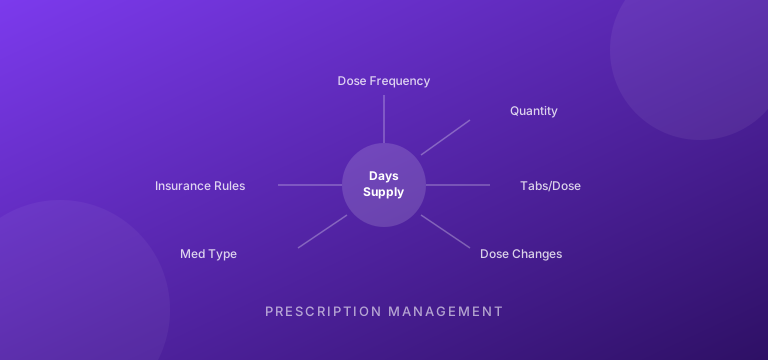
Your days supply isn't just a number on a label. It's the calculation that determines when your insurance will cover your next refill. Most patients assume it's straightforward, but six common factors can change your days supply in ways that affect your refill timeline in real and sometimes frustrating ways.
1. Quantity Dispensed (The Obvious One)
The most direct factor: more tablets = more days supply. If your prescription is written for 30 tablets and you take 1 daily, you get 30 days. If your insurance limits the first fill to 15 tablets (common for new medications or quantity limits), you get 15 days, and your refill date is 15 days out, not 30.
Verify the quantity on your label every time. Short fills happen when insurance applies quantity limits, when the pharmacy is temporarily out of stock, or (occasionally) due to data entry errors.
You can verify the math at any time with the prescription refill calculator: enter quantity, daily dose, and tablets per dose to see the exact days supply.
2. Dose Frequency (Doses Per Day)
A prescription written for "1 tablet twice daily" consumes 2 tablets per day. The same 30-tablet bottle gives you 15 days supply, not 30.
This is where prescription label misreads create problems. The sig line (the dosing instructions) tells you doses per day. "Three times daily" is 3 doses/day. "Every 8 hours" is also 3 doses/day. "Every other day" is 0.5 doses/day, giving you twice the days supply per quantity dispensed.
If your dose changes mid-supply (e.g., your doctor increases you from 1x to 2x daily), your effective days supply drops immediately. The remaining tablets now last half as long, but your pharmacy record still shows the old days supply; which will cause your insurance to deny a refill that you legitimately need earlier.
When your dose changes, contact your pharmacy the same day to update the record.
3. Tablets Per Dose
"Take 2 tablets by mouth daily" is a common instruction for titrated medications. Two tablets per dose at 1 dose/day means 2 tablets consumed daily, halving your days supply compared to "1 tablet daily."
This factor trips up patients who are titrating or tapering. Tapering schedules are particularly complex. A "2 weeks at 2 tablets, then 2 weeks at 1 tablet" schedule has a variable daily consumption that pharmacy systems handle inconsistently.
4. Rounding Rules
Pharmacies always round days supply down (floor function), never up. This follows NABP guidelines and prevents insurance overbilling.
What it means practically: if 45 tablets at 2/day gives you 22.5 days, your days supply is 22, and your refill date is day 22, not day 23. This seems minor, but it compounds across multiple prescriptions and means your actual run-out date is always slightly later than your official refill date.
5. Dose Packs and Pre-Packaged Medications
Medications that come in dose packs, like Z-packs (azithromycin dose packs), birth control pills, or Medrol Dosepak, have days supply set by the package format, not a quantity/dose calculation.
A Z-pack contains a 5-day course. A standard 28-day birth control pack has 28 tablets (21 active + 7 placebo). The pharmacy enters days supply based on the pack structure, which should match your prescriber's instructions.
If you've been given a partial pack due to stock limitations, days supply will be prorated, and may cause insurance issues if you need another pack before the standard refill window.
6. Insurance Quantity Limits
Many insurance plans impose quantity limits. Maximum quantities per fill. That are independent of what your prescriber wrote. Common examples:
- 30-day supply limits: Many plans won't cover more than a 30-day supply at retail pharmacy for certain drug classes
- Quantity per day limits: For some medications (especially pain medications and controlled substances), insurers set maximum units per day that override the prescriber's instructions
- Step therapy requirements: Requiring a lower-dose or generic version before covering higher doses
These limits can result in your pharmacy dispensing fewer tablets than your prescription calls for, giving you a shorter days supply and earlier refill date than expected, but also potentially requiring prior authorization for the originally prescribed quantity.
How These Factors Interact
The most disruptive scenario: a dose change (factor 2 or 3) combined with an insurance quantity limit (factor 6). Your prescriber doubles your dose, which the pharmacy updates in the record. But your insurance has a 60-tablet/month quantity limit that now only covers a 30-day supply instead of the 30 you've been getting. You need a prior authorization for the higher daily dose.
Knowing these factors helps you anticipate issues rather than discover them when you need a refill. Run your numbers through the refill date calculator whenever your dose or supply quantity changes. It's the fastest way to know if your refill timeline shifted.