Quick Answer
Non-adherence to prescription medications costs the US healthcare system $300B annually and causes 125,000 deaths. Here's what actually works to fix it.
Roughly 50% of patients with chronic conditions don't take their medications as prescribed. That's not a minor compliance footnote, it's the direct cause of an estimated 125,000 deaths and $300 billion in avoidable healthcare costs annually in the United States, according to the Annals of Internal Medicine.
The problem isn't that people don't care about their health. Most non-adherence is unintentional and highly fixable with the right systems.
Why People Miss Doses (The Real Reasons)
Forgetting is the most cited reason: particularly for once-daily medications taken at an irregular part of the day. There's no natural trigger for taking a blood pressure pill at 8am if your morning routine doesn't include a consistent anchor activity.
Running out is the second most common cause. Patients who don't track their supply run out of medication before the refill arrives or the next pharmacy trip happens. This is entirely preventable with a prescription refill calculator and a reminder set at the 80% mark.
Cost barriers drive non-adherence in a meaningful segment of the population. A 2022 Kaiser Family Foundation survey found that 29% of adults reported not taking medications as prescribed due to cost; including skipping doses, cutting pills, or not filling a prescription at all.
Side effect avoidance is common but underreported. Patients experiencing GI discomfort, fatigue, or cognitive side effects often reduce their dose or skip doses without telling their prescriber.
"I feel fine" thinking is particularly problematic for asymptomatic conditions. Blood pressure and cholesterol medications prevent future harm that isn't felt. Without symptoms, the daily reminder of why you take the medication is absent.
What Actually Works
Habit Stacking
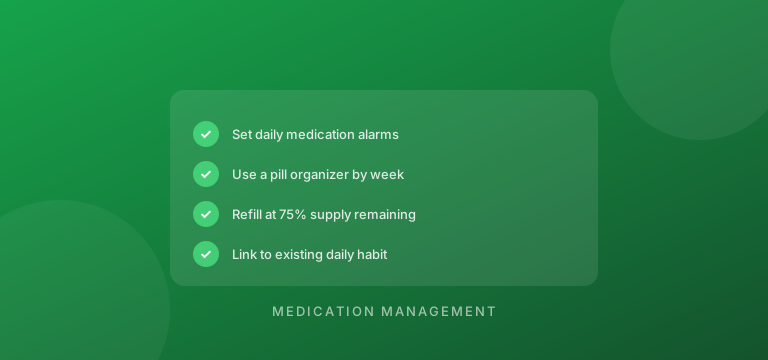
The most consistently effective behavioral strategy is linking medication to an existing daily anchor. "I take my medication after I brush my teeth at night" works better than a phone alarm, because the anchor habit (brushing teeth) is already automatic.
The key is choosing an anchor you do daily at the same time, immediately before or after the medication. Common anchors: morning coffee, first meal, brushing teeth, getting into bed.
Pill Organizers (Dose Tracking)
A weekly pill organizer solves the most common memory problem: not remembering whether you've already taken today's dose. A quick glance at Tuesday's compartment tells you if you took your morning dose without any cognitive effort.
For patients on multiple medications, a compartmentalized organizer (AM/PM, 7-day) reduces confusion and the risk of double-dosing.
Prescription Synchronization
If you're managing 3+ medications with different refill dates, you're running a mental calendar across multiple countdowns. Med sync. Where your pharmacy aligns all your refill dates to the same day. Removes this burden entirely. You pick up everything on one day each month.
More details in our guide to syncing multiple prescription refills.
Set a Refill Reminder, Not Just a Dose Reminder
Most adherence advice focuses on remembering to take the dose, but running out of medication mid-month causes multi-day gaps that are worse than a single missed dose.
Set a second reminder: when to request your refill. The right time is when you hit the 80% mark of your current supply. For a 30-day supply, that's day 24. For a 90-day supply, it's day 72.
Calculate your early eligibility date with our refill date tool and set a calendar reminder on that specific day.
Simplify Your Regimen (Ask Your Doctor)
If you're on multiple medications, ask your prescriber whether any can be combined or dosed less frequently. Extended-release formulations often convert a twice-daily medication to once-daily. Combination pills (e.g., amlodipine/benazepril) reduce the number of separate pills without changing the therapy.
Not all medications have these options, but the question is worth asking: especially if your adherence issues are driven by complexity.
Addressing the Cost Problem
Non-adherence due to cost requires a different set of solutions:
Generic substitution is the first step. Ask your pharmacist whether a generic equivalent is available. Generics are FDA-required to be bioequivalent to the brand-name and typically cost 70-85% less.
Manufacturer patient assistance programs offer significant discounts or free medication for patients who qualify based on income. NeedyMeds.org maintains a comprehensive database.
GoodRx and similar discount programs can reduce costs at the counter below what insurance charges for generic medications. It's worth comparing the cash price via GoodRx against your copay. Sometimes the discount card is cheaper.
Splitting higher-dose tablets works for certain medications (consult your pharmacist first, not all pills can be split safely). If your doctor is willing to prescribe 40mg tablets for a 20mg dose, you get twice the supply at the same cost.
Monitoring: Know When You're Drifting
Adherence isn't binary. Most people go through periods of good adherence punctuated by lapses. The important thing is catching lapses early rather than letting them extend.
A simple tracking method: keep the pill bottle next to your anchor habit item (coffee maker, toothbrush), and whenever you take a dose, flip the bottle upside down. Flip it right-side up after the last dose of the day. If the bottle is in the wrong orientation when your anchor habit triggers, you haven't taken your dose.
For refill tracking, the prescription refill calculator gives you an exact count of days remaining based on your fill date and dose, so you always know where you stand.