Quick Answer
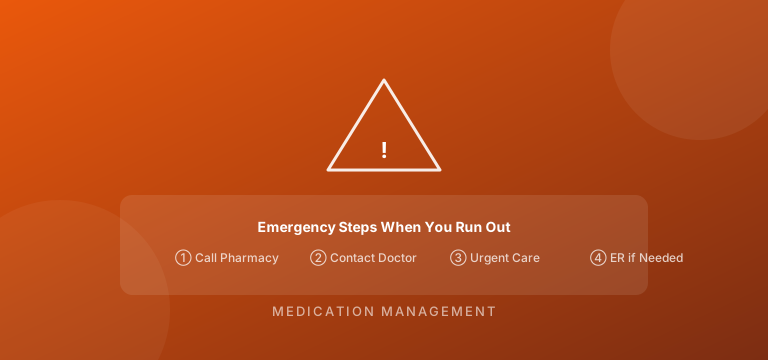
Running out of prescription medication is stressful but usually fixable. Here are the immediate steps, who to call first, and how to prevent it next time.
Running out of a prescription medication before you can refill it happens to most patients at least once. The right move depends on the type of medication, what caused the gap, and how urgent it is. Here's a practical rundown of your options.
Step 1: Assess How Urgent It Is
Not all medication gaps carry the same risk. Categorize the situation:
Immediately urgent (call now):
- Blood thinners (warfarin, rivaroxaban, apixaban). Missing doses increases clot risk
- Anti-seizure medications: gaps can trigger breakthrough seizures
- Insulin and diabetes medications. Blood sugar can destabilize quickly
- Heart failure medications (diuretics, digoxin)
- Psychiatric medications where sudden discontinuation causes withdrawal (SSRIs, benzodiazepines, antipsychotics)
Important but not emergency-level:
- Blood pressure medications (missing 1-2 days rarely causes crisis, but don't skip long-term)
- Thyroid medications (half-life is long; a few missed doses won't cause immediate crisis)
- Cholesterol medications (no short-term risk from a brief gap)
If you're in category one, call your prescriber's urgent line or go to an urgent care clinic immediately. Don't wait for business hours.
Step 2: Call the Pharmacy First
Your pharmacist is the fastest first call, and they have more options than most patients realize.
Emergency dispensing: Most states allow pharmacists to dispense an emergency supply (typically 3-7 days) without a prescription when interrupting therapy poses a health risk. This is a pharmacist's professional judgment call. They can do it for non-controlled medications when it's clinically appropriate.
Partial fill check: Ask whether your current prescription has any remaining quantity that wasn't dispensed. Sometimes a quantity change partway through leaves an unfilled balance.
Prior fill history: If you transferred pharmacies recently, your old pharmacy's prescription might still be transferable. Ask.
Check the exact refill date: Use our prescription refill calculator or ask the pharmacist to pull up your prescription record. Sometimes patients think a refill is due when it's actually still a few days out, which changes the plan.
Step 3: Contact Your Prescriber
If the pharmacy can't resolve it, contact your doctor's office directly.
Most practices have after-hours answering services for urgent medication needs. Be clear and specific: "I've run out of [medication name] and I have [X] days until my prescription can be filled. I need [emergency supply / prescription renewal / vacation override]."
Prescribers can call in emergency 30-day supplies for most non-controlled medications. For controlled substances, they'll need to issue a new written or electronic prescription, which may require an appointment.
For Controlled Substances: The Harder Case
Running out of a Schedule II controlled substance (Adderall, opioids, methylphenidate) before the legal refill date is one of the hardest medication gaps to solve. Options are limited:
- Federal law prohibits early refills for Schedule II drugs under most circumstances.
- DEA vacation exceptions exist but require advance planning and prescriber involvement.
- Urgent care or ER can sometimes provide a bridge supply for legitimate medical need, but controlled substance regulations vary by state and individual providers may decline.
Prevention is the only real solution here. Use a refill date tracker and request renewals at least 7-10 days before the legal refill date.
Traveling and Running Short
Running low while traveling adds logistics to the problem. A few options:
In the US: Your insurance may allow a vacation override, a one-time early refill approved for documented travel. Call your insurance member services number (on the back of your card) and ask about vacation supply authorization. You'll need to provide travel dates.
International travel: Most countries allow a 90-day personal supply of most non-controlled medications. Carry your original prescription label. Controlled substances require advance DEA permission (Form DEA-31) for international travel.
Find a local pharmacy: Major chains (CVS, Walgreens, Walmart Pharmacy) can access your fill history and may be able to transfer your prescription or provide an emergency supply at another location.
How to Prevent Running Out Again
Prevention comes down to knowing your refill window with precision. Most supply gaps happen because patients:
1. Misjudged their remaining supply, miscounting tablets, especially with non-standard doses (half-tablets, dose packs)
2. Forgot to request a renewal before refills ran out, leaving a gap between the last refill and a new prescription
3. Delayed picking up a filled prescription, the pharmacy holds it for 7-10 days before returning it to stock
The fix is straightforward: use a prescription refill calculator to know your exact refill date and early eligibility date, then request your refill as soon as the early window opens. Set a phone reminder on day 22 of a 30-day supply, or day 65 of a 90-day supply.
For patients managing multiple prescriptions, syncing refill dates by asking the doctor to write all maintenance medications for 90-day supplies around the same fill date dramatically reduces the chances of any one medication slipping through the cracks.